
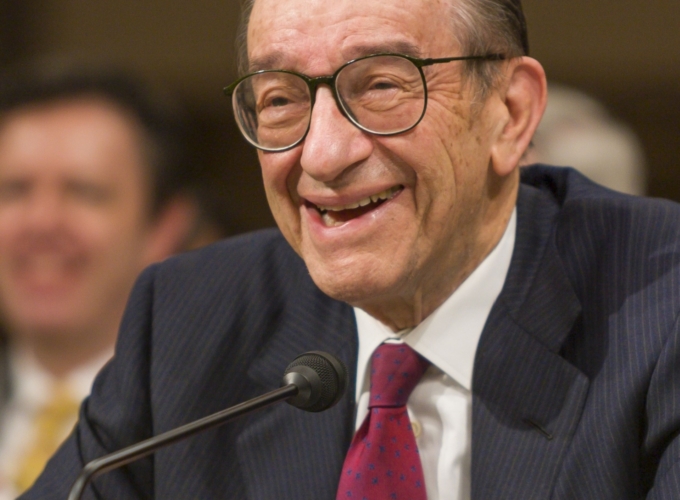
Tribute to Alan Greenspan
We take this opportunity to pay tribute to Alan Greenspan “The Maestro,” who passed away on June 22, 2026.
Serving as Chairman of the Federal Reserve from 1987 to 2006, Greenspan was one of the most influential policymakers of the modern era, guiding the U.S. economy through market crashes, recessions, financial crises, and an unprecedented period of economic expansion. His 18½-year tenure over his five terms remains the second-longest in Federal Reserve history and spanned the administrations of Ronald Reagan, George H.W. Bush, Bill Clinton, and George W. Bush.
Taking the Helm During Turbulant Times
Greenspan assumed leadership of the Federal Reserve on August 11, 1987. Just two months later, he faced his first major test when the stock market crashed on October 19, 1987, with the Dow Jones Industrial Average falling more than 22% in a single day. Greenspan responded swiftly by assuring financial markets that the Federal Reserve would provide the liquidity necessary to maintain stability, a move widely credited with helping prevent a broader financial panic.
During his tenure, Greenspan guided monetary policy through numerous financial shocks, including:
- The 1987 stock market crash
- The 1990-1991 recession
- The Mexican peso crisis (1994)
- The Asian Financial Crisis (1997)
- The Russian debt default and Long-Term Capital Management crisis (1998)
- The dot-com boom and bust (2000)
- The economic disruption following the September 11, 2001 terrorist attacks
In each case, Greenspan sought to balance economic growth with financial stability, helping establish the Federal Reserve as a more proactive and transparent institution.
Championing Price Stability and Economic Growth
Greenspan was known for his strong anti-inflation stance. Throughout much of the 1990s, inflation remained relatively subdued while economic growth accelerated. This combination of strong growth and stable prices helped create one of the most prosperous economic periods in modern U.S. history.
Under Greenspan’s leadership, the United States experienced what many consider the longest economic expansion in its history at that time. Real GDP growth averaged approximately 3% annually during much of the 1990s, while unemployment fell from over 7% in 1992 to 4% by 2000, a level not seen in decades.
In December 1996, Greenspan famously questioned whether “irrational exuberance” had inflated asset values. The phrase instantly became part of financial lexicon and demonstrated his willingness to publicly acknowledge potential market excesses even as stock valuations continued to rise.
Following the September 11 attacks and the bursting of the dot-com bubble, Greenspan led the Federal Reserve in aggressively lowering interest rates to support economic recovery. The federal funds rate eventually fell to 1%, a historic low at the time. While these actions helped stimulate growth, critics later argued that prolonged low interest rates may have contributed to the housing boom that preceded the 2008 financial crisis.
A Legacy of Achievement
No honest assessment of Greenspan’s legacy can ignore the debates that followed his retirement. Admirers credit him with helping deliver nearly two decades of prosperity, low inflation, rising productivity, and economic resilience. Critics contend that his support for financial deregulation and extended low-interest-rate policies contributed to conditions that culminated in the 2008 financial crisis. Yet history’s most influential leaders are rarely remembered because their decisions were uncontroversial. They are remembered because those decisions mattered.
Furthermore, Alan Greenspan’s influence extended far beyond interest rates and economic forecasts. He brought intellectual rigor, analytical discipline, and an unwavering commitment to understanding the complexities of a rapidly changing global economy.
As investors, policymakers, and economists reflect on his life, they will continue to examine the lessons of the Greenspan era: the importance of price stability, the power of monetary policy, the benefits and risks of financial innovation, and the enduring challenge of balancing economic growth with financial prudence.
Alan Greenspan helped shape the economic landscape of a generation. Whether praised as “The Maestro” or scrutinized for policies that continue to be studied today, his impact on modern finance is undeniable, and his legacy will surely influence monetary policy discussions for decades to come.
The information provided herein is for educational purposes only, and should not be construed as advice, including, but not limited to tax, legal, insurance, investment, or retirement advice. For your specific planning needs, please seek the advice of Integris Wealth Management, your tax accountant, attorney, insurance agent, or other professional as appropriate. Investing involves the risk of loss.
More Insights

Final Regulations for Inherited IRAs (Part 1)
Oct 2024
The Curse of Interesting Times…
Feb 2022
5 Ways to Work Effectively With Your Tax Preparer
Jan 2024