

Parallels and Perils: AI Stocks and the Dot-Com Bubble
“History doesn’t repeat itself, but it often rhymes.” – attributed to Mark Twain
The market shimmers with the allure of groundbreaking technologies. Companies investing in the AI boom like NVIDIA (NVDA), Microsoft (MSFT), Alphabet (GOOGL), Meta (Facebook) (META), AMD (AMD) and others are currently basking in the spotlight. Their valuations are soaring, reminiscent of the dot-com boom of the early 2000s. While the potential of AI is undeniable, a prudent investor never forgets the lessons of history. Let’s delve into the parallels between these two eras and, more importantly, explore why diversification remains the ultimate safeguard for your hard-earned capital.
Great Expectations and Market Enthusiasm
Both the dot-com and AI eras witnessed a surge in investor enthusiasm for groundbreaking technologies. In the late 90’s and early 2000’s, the internet promised to revolutionize communication and commerce. Today, AI holds the potential to transform every facet of our lives. But the scenario that played out in the dot-com bubble serves as a stark reminder of what can transpire when optimism outpaces reality. The current AI excitement is reminiscent in that it is fueling sky-high stock valuations – earnings growth would have to be astronomical to support these valuations. While these lofty AI valuations may ultimately prove to be justified, it’s important to be aware that strong narratives could be encouraging investors to prioritize future potential over current financial realities, just as they did during the dot-com boom.
The Risks of a Narrowing Market
We can witness evidence of this narrative by looking into the increasing concentration of capital into a small handful of companies. As the market’s leadership narrows, maintaining disciplined rebalancing becomes ever more crucial. While concentration alone is not a reliable indicator of an impending bubble, history has shown us that proactively managing increasing exposures in single sectors can be a key to successful risk management.
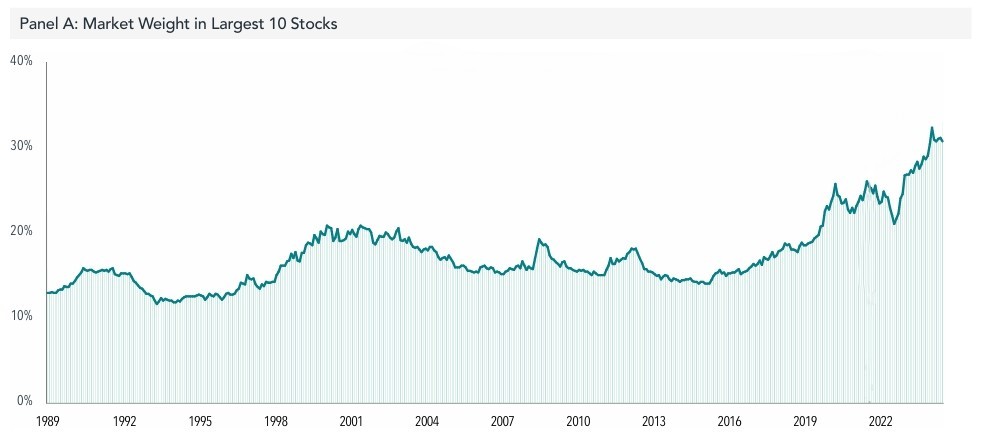
*Data from CRSP analyzing US securities
An often-overlooked reality is that many investors already have significant exposure to the companies leading the AI race through broadly diversified U.S. stock market funds. Large companies such as Microsoft, NVIDIA, Alphabet, Meta, and others represent meaningful weights in major market indexes. While that exposure may help investors participate in the growth of AI, adding separate investments in the same companies — whether through individual stocks or technology-focused sector funds — can unintentionally increase concentration risk. Before making additional investments tied to AI, investors should consider whether they are truly diversifying their portfolios or simply increasing exposure to the same set of companies and risk factors.
When Expectations Outpace Fundamentals
Investor excitement and “mania” in chasing growth can drive stock prices up at an extraordinary rate. The key factor is that at some point, profits need to materialize. If companies fail to deliver the earnings and value to investors, share prices will eventually correct to a level better supported by fundamentals – and particularly when the run-up has been manic, this can happen in a wave leading to a panic market correction. This is where investors get burned. While a handful of internet companies in the dot-com era emerged as tech giants, most were never able to grow into their expectations, leading to a spectacular crash.
There is a case to be made, though, that the landscape today is a bit different – that the AI-driven market run-up may have more long-term legs than what we experienced back in the dot-com era. For one thing, many of the players are much more established than the high-flying dot-com start-up of that previous era. Companies like NVIDIA, Microsoft, Google, Meta, and AMD have strong track records of earnings growth and effective corporate stewardship. They have diversified business lines – and are thus likely to be much better positioned to weather an AI disappointment than many of the dot-com companies were able to weather the storm back then. But while those factors bolster their staying power, the technology is still nascent, and such a disappointment could cause a lot of pain. Since the full scope of AI’s impact is uncertain, there is no reliable way to know which companies will win the race. So, how do you pick a winner? Well, we argue that you don’t try to pick a winner – make sure you’re in the game, but do so in measured and careful way.
The Power of Diversification: Your Ultimate Hedge
AI holds immense promise, but let’s not forget the age-old wisdom – diversification is the cornerstone of prudent investing. Many investors already participate in the potential benefits of AI through broad market ownership. The question is not necessarily whether to invest in AI, but whether additional AI-focused investments improve diversification or simply concentrate risk further. Here’s why diversification remains so important:
- Market Uncertainty: No one can predict the future perfectly. Diversification across regions, sectors, and asset classes mitigates the risk of being overly exposed to a specific trend, like AI, that might not unfold as anticipated.
- Unexpected Events: Black swan events, unforeseen occurrences that disrupt markets, can devastate concentrated portfolios. Diversification acts as a buffer, ensuring your portfolio’s resilience.
- Long-Term Goals: Investment decisions should be aligned with your long-term goals. Diversification helps you navigate market fluctuations and stay on track, regardless of the performance of a single sector like AI.
To add some perspective to the impact of diversification, a concentrated tech index took 16.8 years to recover from its collapse in the dot-com era, while a broader U.S. total market index recovered in 5.7 years, and a broader still global index recovered in just four months. While some may justify their tech portfolios with recent return data, most investors are not in a position to endure a recovery that could last well over a decade.

1Data provided courtesy of Koyfin.
The Takeaway: Embrace the Future, But Prioritize Stability
The rise of AI stocks is an exciting development. However, the dot-com bubble serve as a cautionary tale. Most investors already gain exposure to AI innovators through broadly diversified market portfolios. Before allocating additional capital to individual AI stocks or sector funds, it is worth considering whether those investments truly expand opportunity or simply increase concentration in a handful of companies. The most effective hedge against market volatility remains a well-diversified portfolio that captures growth opportunities across asset classes, sectors, and regions.
1 Koyfin data periods: S&P Tech Index Fund (XLK) data covers 3/27/2000 to 3/1/2017. Total US Market Fund (VTSMX) data covers 3/24/2000 to 10/4/2006. All World Global Fund (VHGEX) data covers 1/13/2000 to 7/3/2000.
The information provided herein is for educational purposes only, and should not be construed as advice, including, but not limited to tax, legal, insurance, investment, or retirement advice. For your specific planning needs, please seek the advice of Integris Wealth Management, your tax accountant, attorney, insurance agent, or other professional as appropriate. Investing involves the risk of loss.
More Insights

Promotion Announcement
Apr 2023
Quarterly Market Commentary – Q1 2026
Apr 2026
A Season of Service at Integris
Jan 2026